
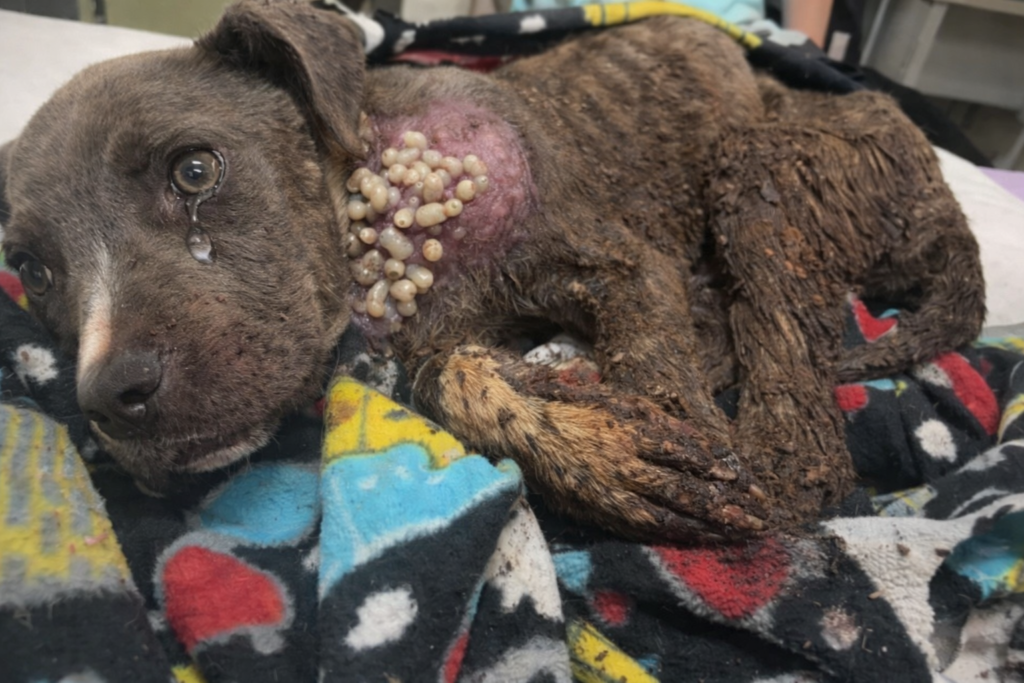
He lay curled on a blanket that tried its best to look cheerful—splashes of bright color beneath a body that could no longer pretend. The air around him carried the sharp, metallic sting of blood and the sour bite of fear. Along his side, the wound rose raw and swollen, a cruel bloom where skin should have been, where fur should have softened the world. His breathing came in thin, trembling pulls, as if each one had to be negotiated with pain. And still, tears slid from his eyes—slow, heavy drops that clung to his lashes before falling into the fabric. Those gentle brown eyes, wide and glassy, held something unbearable: trust that had not yet learned to die.
Not long ago, he had been the kind of dog people smiled at without thinking. He had a name spoken in warm voices, a collar that jingled like a promise, and a home that smelled of soap, dinner, and the familiar footsteps of the ones he loved. In the afternoons he would sprint through open fields, ears flapping, paws drumming the earth as if the ground itself belonged to him. Children would tumble into the grass and he would tumble with them, a blur of joy and clumsy kisses, tail whipping the air so hard it seemed it might lift him. He learned the rhythm of their laughter, the way small hands scratched behind his ears, the comfort of being called back and always returning. In those days, his eyes shone with certainty: the world was safe, and love was permanent.
Then the world changed in a way he could not understand. Maybe it was a door that closed and never opened again, or a car that drove away without him, shrinking into the distance while he ran until his lungs burned. Maybe it was a hand that once fed him, suddenly hard with anger, or a moment of carelessness that turned into catastrophe. All he knew was the shock—one second of ordinary life, and the next a tearing pain that stole his voice. He stumbled, fell, tried to stand, and found his body no longer obeyed the way it used to. The night came cold and indifferent. He dragged himself toward shelter, nails scraping pavement, belly pressed to the ground, leaving behind a trail that told the story he couldn’t speak. He waited for footsteps, for his name, for the familiar scent of home. Only silence answered, and confusion settled over him like dust: why would love disappear when he needed it most?
When someone finally found him, it was not with the casual glance of a passerby, but with a sudden stop—an intake of breath that sounded like grief. The person knelt, and the dog flinched at first, expecting pain the way you expect rain from a dark sky. But the hands that reached toward him were careful, trembling, as if afraid to break what was already broken. The sight of the wound turned the rescuer’s face pale; horror and urgency fought in their eyes. A phone call was made with shaking fingers. A blanket was pulled tighter around him, and he was lifted with a gentleness that felt unfamiliar after so much hurt. His body was limp, heavy with exhaustion, yet when the rescuer whispered soft words—nonsense words, kind words—his tail gave the smallest, weakest thump. It was a fragile gesture, almost nothing, and it shattered the heart of everyone who saw it: even now, he still believed kindness meant safety.
At the clinic, bright lights washed the room in sterile white, and the smell of disinfectant tried to erase the truth of what had happened. Veterinarians moved quickly, voices low and urgent, hands practiced but eyes haunted. They shaved fur, cleaned torn flesh, measured blood loss, and spoke in careful terms that could not soften the reality: he was hanging between life and letting go. Needles slid into veins; monitors beeped like anxious birds. Each treatment was a battle—painful, necessary, cruel in its own way—because saving him meant hurting him again and again. Yet he did not snap. He did not growl. He only trembled, eyes searching faces as if asking whether this suffering had a purpose. When the worst waves of pain hit, his breath hitched and his body stiffened, but he kept returning to the same quiet act of courage: staying. As if somewhere inside him, a small flame refused to be blown out.
There are countless stories like his, scattered across streets and fields and forgotten corners of the world—animals who are born with nothing but the instinct to trust, and who learn too late that humans can be both miracle and monster. It is a particular kind of tragedy, the kind that doesn’t make headlines, the kind that happens in silence while people look away. A dog does not understand cruelty as a choice; it only understands the sudden absence of warmth, the sting of a blow, the hunger that gnaws like a living thing. They do not ask for much—food, shelter, a voice that says, “You’re safe.” And still, some are discarded like broken objects, punished for existing, abandoned when they become inconvenient. What does it say about us, that a creature capable of such uncomplicated love can be met with such thoughtless harm? Perhaps the saddest part is this: even after everything, many of them still reach for us, still hope we will be better than we have been.
In the days that followed, his fate remained uncertain, balanced on the thin edge of medicine and will. Some nights he slept so deeply it frightened the nurses; some mornings he opened his eyes and looked around as if searching for the reason he was still here. But whenever a gentle hand touched his head, whenever a voice spoke softly near his ear, that same fragile trust flickered back to life. It was not naïve—it was brave. He had every reason to surrender, and yet he chose, again and again, to believe in tenderness. If his story leaves a weight in your chest, let it become something more than sorrow. Let it become a promise: to notice, to care, to stop and help when you can. Because kindness is not small to the one who is suffering. To an injured dog on a bright blanket, it can be the difference between the end—and another chance to live.