
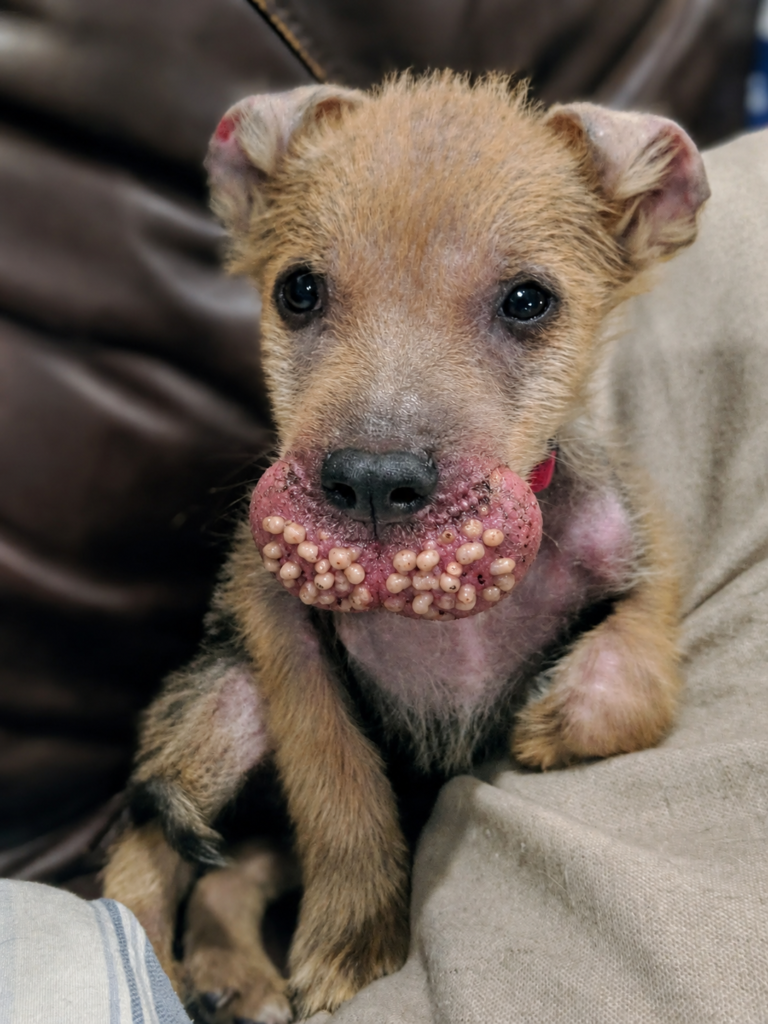
In a quiet corner of a crowded street, beneath the noise of passing vehicles and the indifference of hurried footsteps, sat a tiny puppy whose eyes carried more pain than any creature should ever know. His small body trembled with weakness, but it was his face that stopped people in their tracks. Painful growths and severe skin infections had spread around his mouth and face, making even the simplest acts—eating, sleeping, or barking—agonizing.
Most people looked away.
Some felt pity for a moment before continuing on with their lives. Others whispered that he looked frightening. But very few stopped to imagine what this puppy had endured every single day.
This is not just the story of a sick puppy. It is the story of abandonment, suffering, resilience, and the desperate need for compassion in a world where animals often suffer silently.
The puppy was born in a neglected alley behind a row of old shops. His mother, a thin stray dog, had spent years surviving on scraps and dirty water. Every day was a battle against hunger, disease, and danger. Yet despite her own suffering, she tried to protect her litter with every ounce of strength she had.
At first, the puppy looked healthy. He was playful, curious, and energetic like any young dog should be. He chased leaves blowing in the wind, stumbled clumsily over broken pavement, and curled beside his siblings for warmth each night.
But within weeks, strange patches began appearing on his skin.
The fur around his face started falling out. Small bumps formed around his lips and eyes. His skin became inflamed, swollen, and painfully irritated. Soon, the condition worsened rapidly. The bumps turned into clusters of infected growths, making it difficult for him to open his mouth properly.
Hunger became torture.
Every attempt to eat caused pain. Even drinking water made him whimper softly. As the infection spread, flies gathered around his wounds. His tiny body grew weaker day after day.
People noticed him, but not in the way he needed.
Children pointed at him in fear. Some adults believed he carried a dangerous disease and chased him away with sticks or stones. Shopkeepers sprayed water to keep him from resting near their stores. Instead of kindness, he met rejection.
And still, the puppy survived.
He hid beneath abandoned carts during rainy nights. He searched through garbage piles for food, often finding nothing but rotten leftovers. Sometimes he went days without eating. His once-bright eyes became dull with exhaustion.
Pain changed him.
The playful puppy who once chased butterflies now sat silently in corners, too weak to move. His body itched constantly from the skin infection, but scratching only caused bleeding. He cried at night—not loudly, but in soft broken sounds that echoed through empty streets.
No one came.
Skin diseases in stray animals are tragically common. Mange, fungal infections, untreated wounds, parasites, and tumors often spread rapidly among dogs living without shelter or medical care. Many conditions that could easily be treated in a veterinary clinic become life-threatening when ignored.
But animals cannot ask for help.
They cannot explain their suffering. They simply endure it.
One cold evening, as traffic slowed under heavy rain, a young woman noticed the puppy curled beside a drainpipe. Unlike others, she did not turn away. She crouched carefully and looked into his eyes.
What she saw was not something ugly or frightening.
She saw fear.
She saw exhaustion.
And beneath all the pain, she saw a life still fighting to survive.
The puppy tried to back away, terrified of humans after months of cruelty. But he was too weak to run. The woman gently offered him food, though he struggled painfully to eat. Tears filled her eyes as she realized how severe his condition had become.
She knew that without treatment, he would not survive much longer.
Carefully, she wrapped him in a blanket and carried him to a nearby veterinary clinic. For the first time in weeks, the puppy felt warmth and safety.
At the clinic, the veterinarians were shocked by his condition. His skin infection had spread deeply, causing severe inflammation and tissue damage around his mouth. He was malnourished, dehydrated, and suffering from secondary infections caused by bacteria and parasites.
Treatment would not be easy.
The puppy needed antibiotics, medicated baths, pain relief, proper nutrition, and constant monitoring. There was no guarantee he would recover fully. Some of the damage might remain forever.
But for the first time in his life, someone was willing to try.
The first few days were heartbreaking.
The puppy cried during treatment because his wounds were extremely painful. He refused food at times, too weak and traumatized to trust anyone. Yet the veterinary staff continued caring for him gently, speaking softly and cleaning his wounds with patience.
Slowly, tiny changes appeared.
He began drinking water without fear. His appetite improved little by little. The swelling around his face reduced slightly. Though his scars remained severe, his eyes regained a small spark of life.
Recovery was painfully slow.
Weeks passed before he could wag his tail again.
But emotional wounds heal slower than physical ones. The puppy remained nervous around sudden movements. If someone raised their voice nearby, he flinched immediately. Trauma had taught him that humans often bring pain.
Still, kindness began rewriting his story.
Volunteers spent time sitting beside him quietly so he could learn trust again. They gave him soft blankets, clean food, and gentle affection. For the first time, he experienced what it felt like to be safe.
His transformation amazed everyone.
Though scars covered parts of his face, the puppy slowly became playful again. He learned to enjoy toys, sunshine, and human companionship. The same eyes once filled with despair now carried cautious hope.
Yet his story reflects a much larger tragedy happening every day around the world.
Millions of stray animals suffer from preventable diseases simply because no one notices them—or worse, because people choose not to care. Skin conditions in dogs are often treatable when addressed early, but untreated infections can destroy entire lives.
Animals living on streets face impossible odds. They battle hunger, injury, weather, abuse, and disease without protection. Puppies are especially vulnerable because their immune systems are weak and they depend entirely on their surroundings for survival.
The saddest part is that suffering often becomes invisible.
People become so accustomed to seeing injured animals that they stop reacting emotionally. A sick dog on the roadside becomes just another background image in daily life. Compassion fades when suffering becomes common.
But every animal feels pain.
Every frightened puppy hiding under a car, every wounded dog searching for food, every abandoned pet trembling in the rain—they all experience fear, loneliness, and suffering as deeply as any living creature.
The puppy’s recovery did not erase his painful past. His scars remained as reminders of everything he endured. Yet those same scars also became symbols of survival.
Today, he lives in a rescue shelter surrounded by people who care for him. He still requires medical attention, but he no longer fights for survival alone. Volunteers describe him as gentle, affectionate, and incredibly brave despite everything he experienced.
Sometimes he sits quietly near the shelter gate, watching people pass by. Perhaps he remembers the days when the world ignored him. Or perhaps he simply enjoys the peace he once thought impossible.
His story teaches an important lesson.
Compassion does not always require grand actions. Sometimes saving a life begins with stopping, noticing, and choosing not to look away. A small act of kindness—a bowl of food, a call to a rescue group, or medical help for a suffering animal—can completely change a life.
The puppy who once suffered alone in silence now has something he never had before:
Hope.
And for countless other animals still suffering on the streets, hope begins when humans decide their pain matters too.