
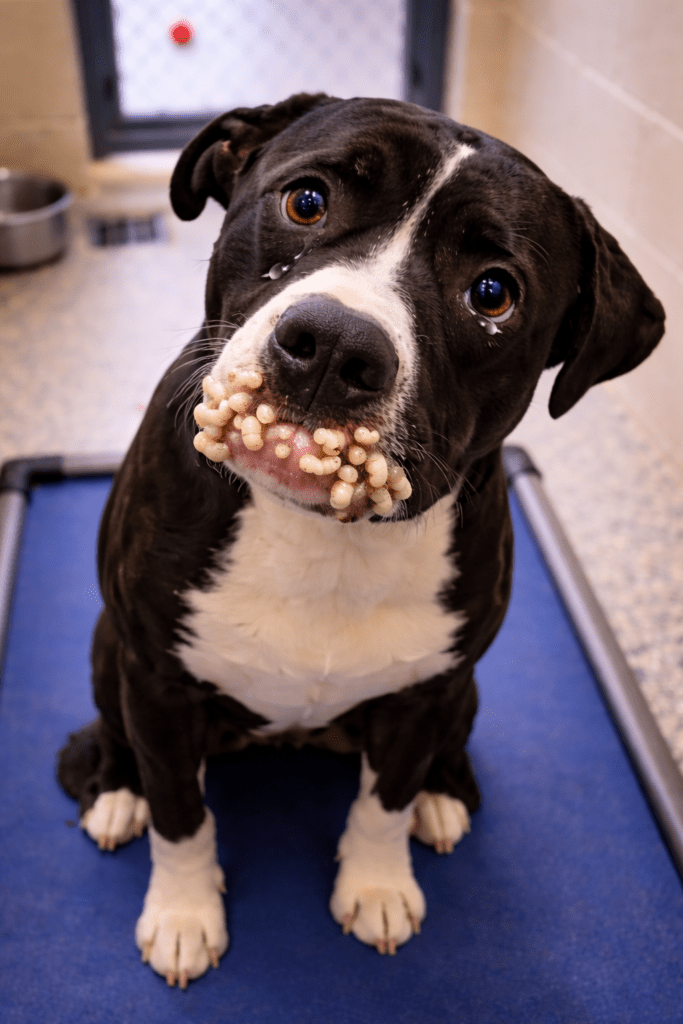
She had been at the shelter for four days, and still, every sound made her look up as if she had been called for the wrong reason.
A metal bowl touched the floor in the next kennel, and her eyes lifted instantly. A latch clicked somewhere down the hall, and her small body stiffened without thinking. Footsteps slowed near her door, and she sat up straighter on the folded gray blanket—not with excitement, but with quiet, guarded attention.
This was not the alertness of curiosity.
This was the alertness of a dog who had learned that change often comes without warning.
Someone had dressed her in a soft pink shirt because she had been cold when she arrived. It wrapped gently around her small chest, making her look cared for in a way her eyes had not yet accepted. The shirt was warm, soft, comforting—but comfort is not something a broken routine can immediately repair.
She sat beneath the stainless wall, her tiny paws placed carefully near the edge of the bedding, as if she wasn’t entirely sure how much of this space truly belonged to her.
The water bowl was full.
The blanket was clean.
The room was safe.
Nothing was wrong in the practical sense.
And yet… everything inside her still felt uncertain.
She looked like a dog waiting for the moment comfort might be taken away again.
That was the first thing the staff noticed.
Not fear in the loud, visible way. Not panic. Not aggression.
Just caution—deep, quiet, and constant.
She didn’t bark.
She didn’t pace.
She didn’t scratch at the kennel door.
She simply watched.
Her large, wet eyes followed every movement around her, as if she had already learned that the worst moments in life don’t always come with noise. Sometimes they come softly. Sometimes they come quietly. And sometimes they come without explanation.
Even when she rested, she never fully relaxed. Her body stayed slightly gathered, slightly prepared—as if she might need to get up quickly and adjust to something new.
The pink shirt, the soft blanket, the steady meals—none of it reached the place inside her that had gone still.
By evening, she would sit in the same spot for long stretches, staring through the kennel opening. Watching. Waiting. Thinking in the only way a dog can—through feeling.
Then slowly, she would lower her head, as if remembering something she didn’t want to remember completely.
When a volunteer knelt near her kennel and spoke softly, she listened.
When a gentle hand moved closer, she became very still.
She never snapped.
Never growled.
Never leaned in.
She simply allowed the moment to exist… without trusting it.
Before the shelter, she had likely belonged to someone. Not in a dramatic way, not in a story filled with grand affection—but in the quiet, ordinary way most dogs belong.
A door that opened at a certain time.
A bowl placed in the same corner.
A familiar voice calling from another room.
A life built on repetition.
For small dogs especially, routine becomes their world. They don’t question it. They depend on it.
They believe in return.
And when that pattern breaks, they don’t understand why.
They don’t analyze. They don’t blame.
They simply feel the absence.
Maybe she had been left behind during a move.
Maybe she became too much responsibility.
Maybe someone promised to come back… and never did.
Whatever the reason, it didn’t make her wild.
It made her careful.
That carefulness was what she carried with her into the shelter. Not just sadness. Not just confusion. But a quiet, steady caution that shaped everything she did.
The staff recognized it immediately.
And instead of trying to change her quickly, they chose to respect it.
They kept her water bowl in the same place every day.
They folded her blanket the same way after cleaning.
They spoke gently before opening her kennel door.
They moved slowly, predictably—never rushing her into being “okay.”
Because healing, for a dog like her, is not something that can be forced.
It has to be built.
One small moment at a time.
By the second day, something shifted.
She stopped shrinking every time the latch made a sound.
By the third day, she began eating before the person had fully stepped away.
These were small changes—almost invisible to someone who didn’t know what to look for.
But to the people who cared for her, they meant everything.
Then came the fourth day.
A volunteer noticed something small, something easy to miss.
The little dog had started sleeping with her chin resting on the edge of her pink shirt, gently bunching the fabric beneath her mouth. As if she needed one soft thing to hold onto.
No one made a big deal about it.
That’s how progress happens with dogs like her—quietly, without announcement.
A longer nap.
A softer posture.
A step closer to the kennel door.
She was still sad. That hadn’t changed. You could see it in the way she looked up at people, searching their faces as if hoping to find an answer that would make sense of everything she had lost.
But now, something else was beginning to exist alongside that sadness.
Routine.
Morning came, and her bowl was filled again.
The blanket was replaced, folded the same way.
The same voices greeted her.
The same light filtered through the hallway.
Nothing disappeared halfway through care.
Nothing changed suddenly.
And for her, that consistency meant more than affection ever could.
Because before trust comes love…
There has to be predictability.
One quiet afternoon, during the slowest part of the day, a volunteer sat outside her kennel and began reading aloud from inventory notes. Not because the dog needed information—but because she needed presence.
No pressure.
No expectation.
Just a voice that stayed.
The little dog listened for a while. Her ears moved slightly with each word. Then, slowly, she lowered herself onto the blanket—without taking her eyes off the woman.
It was the first time she had chosen to lie down while someone was still there.
That moment mattered.
More than excitement.
More than play.
Because it meant she was beginning to believe something new:
That she didn’t always have to stay ready to leave.
That evening, the shelter grew briefly noisy as shifts changed and footsteps filled the hallway. She startled once, her body reacting before her mind could.
But then she looked toward the door…
And stayed where she was.
She didn’t retreat.
She didn’t panic.
She stayed.
That word became important to the staff.
“She stayed when I changed her bowl.”
“She stayed when I opened the kennel.”
“She stayed when I reached for her blanket.”
It sounded small.
But it was everything.
Because staying meant she was learning that not every movement around her led to loss.
And then came the fifth morning.
The volunteer who had greeted her every day opened the kennel door and paused.
The blanket was no longer flat. It had been gently shaped into a small nest. The pink shirt was wrinkled beneath her chin.
And instead of sitting far back in the corner…
She was near the front.
Still. Quiet. Watching.
Her eyes were the same—soft, sad, searching.
But now… there was something new in them.
Not joy.
Not complete trust.
But recognition.
She knew this person.
She knew this routine.
She knew this moment would not disappear suddenly.
And for the first time since she arrived…
She didn’t look like a dog waiting to lose everything.
She looked like a dog beginning to believe she might not.
Conclusion: Healing Happens Quietly
Some dogs heal loudly—with wagging tails and excited jumps.
But dogs like her… heal quietly.
In stillness.
In patience.
In small, almost invisible moments.
Her story is not about instant happiness.
It is about something deeper.
It is about learning to stay…
When everything inside you has learned to leave.
And somewhere, beyond that kennel door, there is a future waiting for her.
A home that won’t change suddenly.
A voice that won’t disappear.
A love that doesn’t come with conditions.
And when that day comes…
She won’t just go with them.
She will stay.