
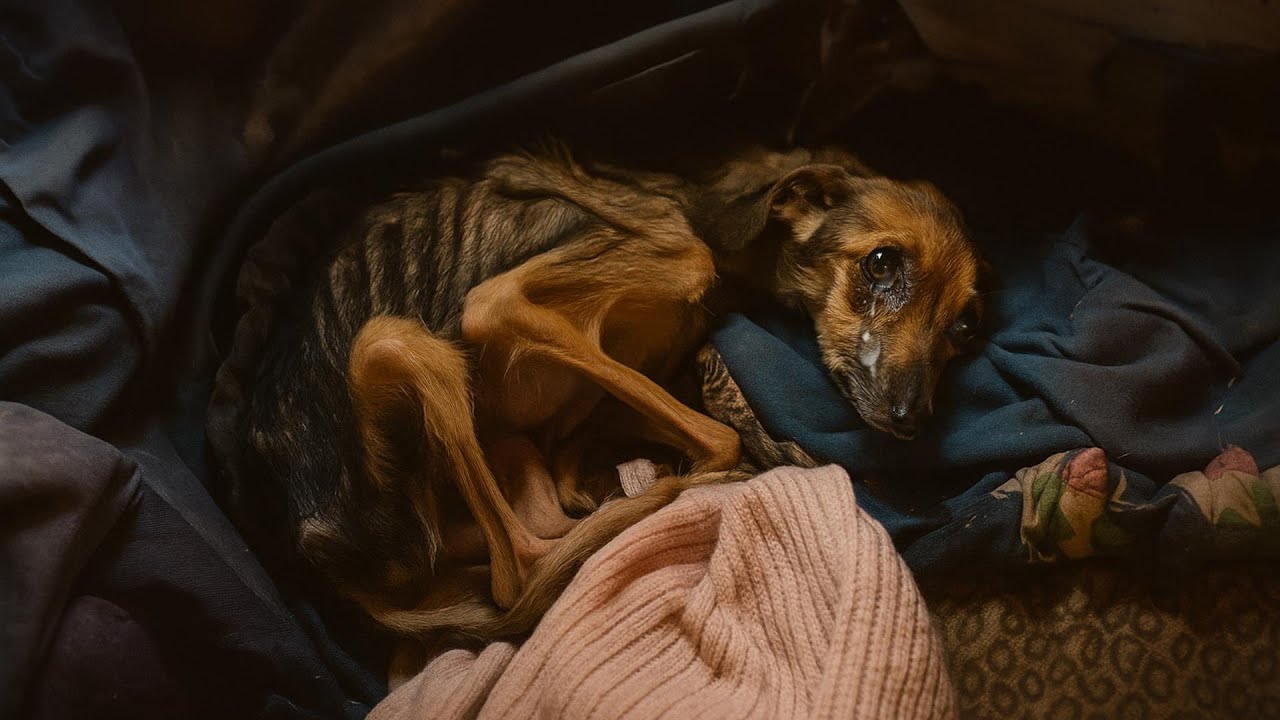
She lay in filth, her body frozen and forgotten, on the edge of a narrow alley where the city’s noise faded into indifference. No one knew how long she had been there. Some said days, others insisted it had only been a night, but time seemed irrelevant when no one stopped to care. The rain had washed the streets clean, yet it had done nothing for her. Her fur, once golden and soft, clung to her fragile frame in muddy clumps. Her breathing was shallow, almost invisible, as if she herself had already accepted the silence closing in around her.
The dog had no name—at least none that anyone remembered. But there was a time, not too long ago, when she had been more than just another stray. She had belonged somewhere, to someone. She used to run freely in a small yard, chasing shadows and sunlight, her tail wagging with an innocence that only animals seem to carry. Children laughed when she barked at butterflies, and a gentle hand would always be there to feed her at the end of the day. Life had been simple then, full of warmth and belonging.
But something changed. Perhaps it was a move, or a loss, or simply the quiet cruelty that sometimes finds its way into human hearts. One day, the gate was left open, or maybe she was pushed out—it no longer mattered. She wandered at first, expecting to find her way back, believing that someone would call her name. But no one did. Days turned into weeks, and survival replaced comfort. Hunger gnawed at her constantly, forcing her to search through garbage piles and fight off stronger strays for scraps. The world she once trusted had become harsh and unforgiving.
Now, lying in that alley, her body weak and trembling, she no longer had the strength to search or fight. People passed by, their footsteps quick, their eyes avoiding the scene. Some noticed her but chose to look away, convincing themselves that someone else would handle it. Others didn’t see her at all, lost in their own hurried lives. The city moved on, as it always did, leaving her behind.
Hours passed, or maybe it was longer. The sky shifted from gray to a pale hint of evening. Then, amidst the indifference, something changed. A boy, no older than twelve, slowed his steps as he walked past the alley. He stopped, turned, and looked again. Unlike the others, he didn’t look away. There was hesitation in his eyes, but also something else—curiosity, maybe even concern. He stepped closer, cautiously, as if approaching something fragile that might break.
“Hey,” he whispered, his voice soft and unsure.
The dog didn’t move at first. Then, with great effort, her eyes opened slightly. There was no bark, no wag of the tail—only a faint flicker of awareness. But it was enough. The boy’s expression shifted, and in that moment, a decision was made.
He didn’t have much—just a small bag slung over his shoulder and a few coins in his pocket. But he knelt beside her, ignoring the dirt, the smell, and the discomfort that had driven everyone else away. He reached out slowly, letting his hand hover before gently touching her head. She didn’t pull away.
“I won’t leave you,” he said, more to himself than to her.
What followed wasn’t dramatic or immediate. There was no sudden miracle, no instant recovery. But there was effort. The boy ran home and returned with water in a plastic container and pieces of bread wrapped in paper. He coaxed her to drink, guiding her gently, patiently. It took time, but she responded, weakly at first, then with slightly more strength.
Over the next few days, the alley became less of a place of abandonment and more of a fragile refuge. The boy came back again and again, bringing what little he could. Sometimes it was food, sometimes just his presence. And slowly, almost imperceptibly, the dog began to change. Her breathing grew steadier. Her eyes stayed open longer. She started to recognize him, her gaze following his movements with quiet trust.
Word spread, as it often does in small, unexpected ways. A shopkeeper nearby noticed the boy’s visits and began leaving scraps aside. A woman who lived across the street offered an old blanket. Someone else suggested calling a local animal rescue group. What had once been a scene of neglect began to shift into something else—a small, collective act of care.
When the rescue team finally arrived, they found not just a dying stray, but a dog who had been given a second chance before they even got there. She was carefully lifted, wrapped, and taken to a place where she could heal properly. The boy watched as they drove away, his face a mixture of worry and hope.
Weeks later, he would see her again. Clean, healthier, and standing on her feet, her tail wagging gently as if remembering how. She wasn’t the same as before—life had left its marks—but she was alive. And when she saw him, she moved toward him, slowly but surely, as if crossing the distance between past and present.
This story is more than just a tale of a stray dog. It is a reflection of how easily suffering can be ignored—and how powerful even a single act of kindness can be. In a world that often rushes past pain, it reminds us to stop, to notice, and to care. Because sometimes, saving a life doesn’t require extraordinary resources or grand gestures. Sometimes, it begins with simply choosing not to walk away.