
The afternoon sun burned over the crowded marketplace, where people moved quickly from one shop to another. Vendors shouted prices, motorcycles pushed through narrow streets, and the smell of dust and food mixed heavily in the hot air. In the middle of all that noise and movement, one dog sat quietly beside a broken wall near the edge of the bazaar.
Most people avoided looking at him.
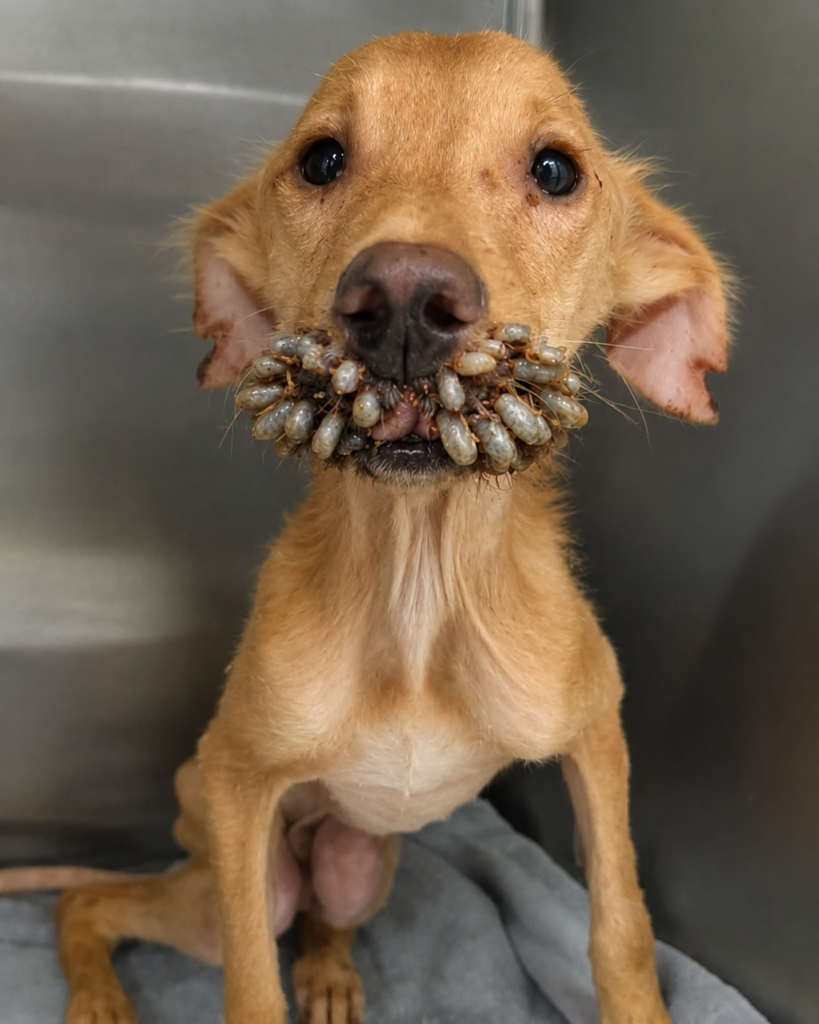
He was thin, weak, and covered in dirt. His fur had once been soft, but now it looked rough and uneven. What frightened people the most was his mouth. Around his lips and face, large ticks clung tightly to his skin. Some were swollen with blood, while others crawled slowly through the thin patches of fur near his eyes and ears.
Every few minutes, the dog tried to scratch his face with his paw, but he was too tired to keep trying. He would stop, lower his head again, and stare silently at the ground.
Children pointed at him from a distance. Some people whispered that he might be dangerous or sick. Others simply ignored him and kept walking. For days, he had remained there near the market, surviving on scraps thrown beside trash piles and dirty water collected near the roadside.
No one knew how long he had been suffering.
The dog never barked.
He never chased anyone.
He simply waited.
Sometimes he looked at passing people with quiet hope in his eyes, as if he still believed someone might stop for him. But every evening, the market lights would dim, the shops would close, and he would still be sitting there alone.
One shopkeeper later told us that the dog used to follow people around when he first appeared in the bazaar. He would slowly walk behind customers, wagging his tail weakly, hoping for food or kindness. But after being shouted at, kicked away, and ignored too many times, he eventually stopped trying.
By the time our rescue team heard about him, he had almost completely given up.
A local fruit seller sent us a photo late in the evening. The message was short:
“Please help this dog. Nobody will go near him.”
The picture was heartbreaking.
The dog’s face looked swollen from the ticks feeding around his mouth and ears. His eyes were tired and filled with pain. Even through the photo, we could see fear and exhaustion written across his body.
The next morning, our team drove to the market.
The bazaar was already crowded when we arrived. People watched curiously as we searched through the busy streets. Some pointed toward the corner where the dog usually stayed.
And there he was.
Sitting exactly where the photo had shown him.
Up close, his condition was even worse than we expected. Ticks covered parts of his lips, neck, and ears. His ribs pressed visibly against his skin. There were wounds on his legs, likely from lying on rough concrete for too long.
But despite everything he had suffered, the dog did something unexpected when we approached him.
He wagged his tail.
Slowly.
Carefully.
As if he still wanted to trust humans.
One of our rescuers knelt a few feet away and spoke softly to him. The dog looked frightened at first and tried to move back, but he was too weak to run far. We placed food near him, and after a moment of hesitation, he began eating carefully, glancing up between bites as if afraid the food might suddenly disappear.
People gathered around us while we worked.
Some looked shocked when they saw the number of ticks attached to his face. Others asked whether the dog would survive. A few admitted they had seen him suffering for many days but did not know what to do.
Sadly, this happens more often than people realize.
Street dogs suffer silently in crowded places every day. Illness, hunger, infections, wounds, and parasites slowly destroy their bodies while thousands of people walk past them without stopping. Sometimes it is not cruelty that hurts them most.
It is being invisible.
We gently wrapped the dog in a blanket and lifted him into the rescue vehicle. He did not fight back. He simply rested his head against the seat and closed his eyes.
For the first time in many days, he was finally safe.
At the clinic, treatment began immediately.
Removing the ticks took hours.
Some were deeply attached around his lips and ears, causing painful swelling and infection. The veterinary team worked carefully to clean his wounds and remove every parasite one by one. The dog remained calm the entire time, even though he was clearly uncomfortable.
It was as though he understood that people were finally trying to help him.
After the treatment, he received medicine, food, and a warm place to sleep. He ate slowly at first because of the pain around his mouth, but by the second day, his appetite had started to return.
The biggest change, however, was in his eyes.
The fear slowly faded.
Each morning, when our team entered the clinic room, his tail would tap softly against the floor. He began following staff members around the room. Sometimes he would rest his head gently on someone’s lap, quietly asking for affection he had probably not felt in a very long time.
One volunteer became especially attached to him.
She said the dog would always wait near the clinic door when he heard her footsteps. No matter how weak he felt, he would stand up and greet her. She often sat beside him after treatment sessions, speaking softly while cleaning his wounds.
“Dogs remember kindness,” she said one evening. “Even after humans fail them.”
Week after week, the dog slowly recovered.
Fresh fur began growing around his face. The swelling reduced. The wounds healed. His body gained strength again. And little by little, the sad dog from the marketplace started to disappear.
In his place was a gentle, loving animal who only wanted safety and care.
The transformation shocked everyone who had first seen his rescue photo online. Many people could not believe it was the same dog.
But perhaps the most emotional moment came when our team returned to the same bazaar weeks later.
This time, the dog was healthy enough to walk proudly beside us on a leash.
The same shopkeepers who once watched him suffer came forward smiling. Some offered him food. Others bent down to pet him carefully. Children who had once been afraid now laughed as he wagged his tail happily.
The dog looked completely different.
Not because he had become another animal.
But because someone had finally shown him compassion.
Before rescue, people only saw disease, dirt, and ticks.
After rescue, they finally saw a living soul.
Stories like his remind us of something important: animals do not need perfect homes, expensive gifts, or grand promises. Sometimes all they need is one person willing to stop and care.
One act of kindness can save a life that the world has forgotten.
That dog sat in the market for days surrounded by hundreds of people, yet he remained alone until someone chose to notice him.
Many street animals are still waiting the same way.
Hungry.
Injured.
Covered in wounds.
Hoping someone will stop.
And sometimes, the difference between life and death begins with a single moment of compassion.