
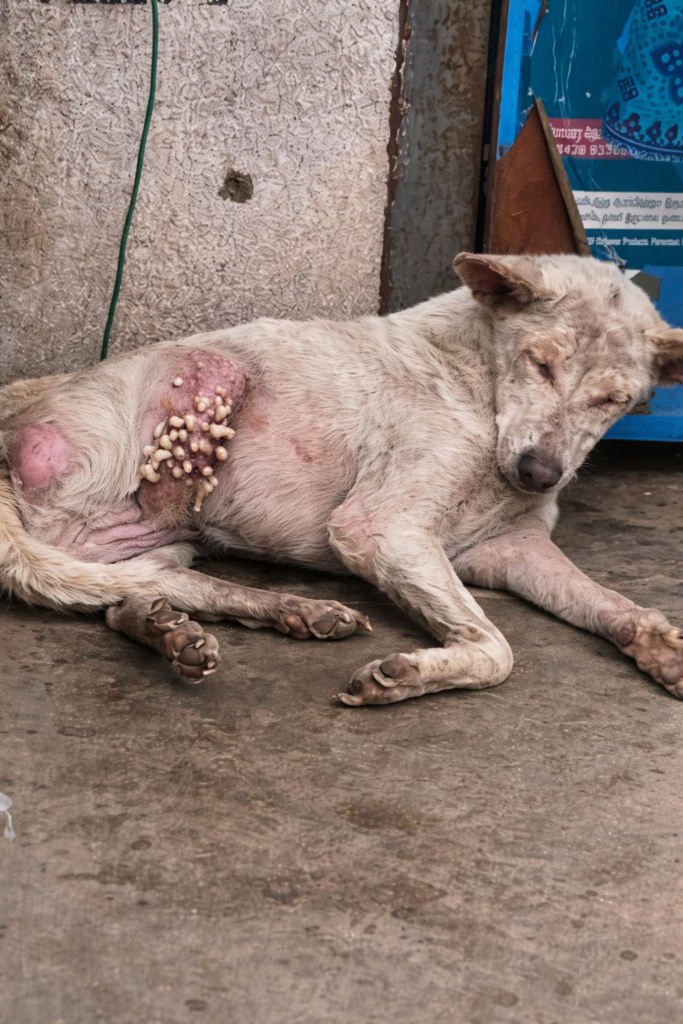
On a quiet evening, when the streets were wrapped in the fading glow of the setting sun, something unusual happened—something that would shake the conscience of anyone who witnessed it. A stray dog, weak and wounded, walked slowly along the roadside. His body was thin, his fur dirty and patchy, and his eyes carried a deep, unbearable sadness. But what made this moment unforgettable was not his condition—it was his voice.
Yes, the dog was speaking.
At first, people thought it was some kind of illusion or trick of the mind. A few laughed nervously, others stepped back in fear. But then the dog spoke again, clearly this time, his voice trembling with pain.
“Why do you ignore us?” he asked.
The street fell silent.
The dog sat down, gathering what little strength he had left. His eyes moved slowly across the faces of the people standing around him—some curious, some uncomfortable, and some completely indifferent.
“I have walked these streets all my life,” he continued. “I have seen kindness… but I have seen more cruelty.”
His voice wasn’t loud, but every word carried weight. It was the kind of voice that didn’t need to shout to be heard—it pierced directly into the heart.
A Life No One Chose
“I was not always like this,” the dog said, looking down at his fragile body. “I was born just like any other living being—with hope, with innocence.”
He described his early days, playing with his siblings, chasing small things, and sleeping close to his mother for warmth. Life, though simple, was peaceful.
“But then one day,” he paused, “everything changed.”
His mother disappeared. His siblings were taken away. He was left alone, too small to understand what had happened, too weak to survive on his own.
“That was the day I learned what abandonment feels like.”
The people listening began to shift uncomfortably. Some lowered their eyes.
Hunger, Fear, and Survival
“Do you know what it means to sleep hungry every night?” the dog asked.
No one answered.
“It means your body becomes your enemy. It weakens you. It drains you. It makes you forget what it feels like to be full.”
He talked about searching through garbage for food, being chased away with sticks, and being kicked for simply existing.
“I was not stealing,” he said softly. “I was just trying to survive.”
A child in the crowd began to cry.
The dog continued, “Sometimes, I would find a piece of bread. Sometimes, nothing at all. But the worst part was not the hunger—it was the way people looked at me, like I didn’t matter.”
The Cruelty of Humans
His voice grew heavier.
“There are people who show kindness,” he admitted. “But there are many who show cruelty without reason.”
He lifted one of his legs slightly—it was injured, swollen.
“This happened because someone threw a stone at me,” he said. “Not because I attacked. Not because I did anything wrong. Just because I was there.”
The crowd fell completely silent.
“Why?” he asked again. “Why do you hurt those who cannot defend themselves?”
No one had an answer.
The Invisible Pain
“Pain is not always visible,” the dog continued. “You see my wounds, my thin body… but you do not see what I feel inside.”
He spoke about loneliness—the kind that comes from being unwanted. The kind that slowly breaks the spirit.
“I stopped trusting humans,” he said. “Every time someone came close, I expected pain.”
He paused, then added, “Do you know how it feels to be afraid all the time?”
A Glimpse of Kindness
But not all his memories were filled with darkness.
“There was one person,” he said, his eyes softening slightly. “A man who gave me food once.”
He described how that one small act changed his entire day.
“I waited for him every day after that,” he said. “But he never came back.”
Even a single moment of kindness had left a lasting impact.
“That is how powerful kindness is,” he whispered.
A Question for Humanity
The dog slowly stood up again, struggling but determined.
“I do not ask for much,” he said. “A little food. A little water. A little kindness.”
He looked directly at the people around him.
“Is that too much to give?”
No one moved.
“Why do you build homes so big, yet leave no space for compassion?” he asked. “Why do you teach your children to speak, but not to be kind?”
His words were simple, but they struck deeply.
The Reflection
One by one, people began to realize something uncomfortable—that the dog was not just telling his story. He was holding up a mirror.
A mirror that reflected human behavior.
A mirror that showed neglect, indifference, and cruelty.
But also, a mirror that showed the possibility of change.
A Call to Change
“You can change this,” the dog said.
“You don’t need to save the world. Just help one life. Feed one hungry animal. Offer water. Show kindness.”
He looked at a small boy standing near the front.
“Even you can make a difference,” he said gently.
The boy nodded, tears in his eyes.
The Final Words
The dog’s voice began to fade.
“I am tired,” he admitted.
“But before I go… I want to say one thing.”
He looked at everyone one last time.
“Kindness costs nothing, but it means everything.”
With that, he slowly lay down on the ground.
No one spoke.
For the first time, the street was not filled with noise—it was filled with understanding.
After the Silence
Something changed that day.
A woman brought a bowl of water and placed it beside the dog. A man brought food. The child sat near him, gently patting his head.
People who had once ignored him were now seeing him—not just as a stray dog, but as a living being with feelings, pain, and a story.
And maybe that was the real miracle.
Not that the dog spoke.
But that, for the first time, humans listened.
Conclusion
The story of the speaking stray dog is not just a fantasy—it is a powerful reminder of a reality we often choose to ignore. Stray animals live among us every day, silently suffering, hoping for a small act of kindness.
They may not speak our language, but their pain is real.
Their hunger is real.
Their fear is real.
And so is their hope.
The question is—not whether they can speak.
The question is—are we willing to listen?