
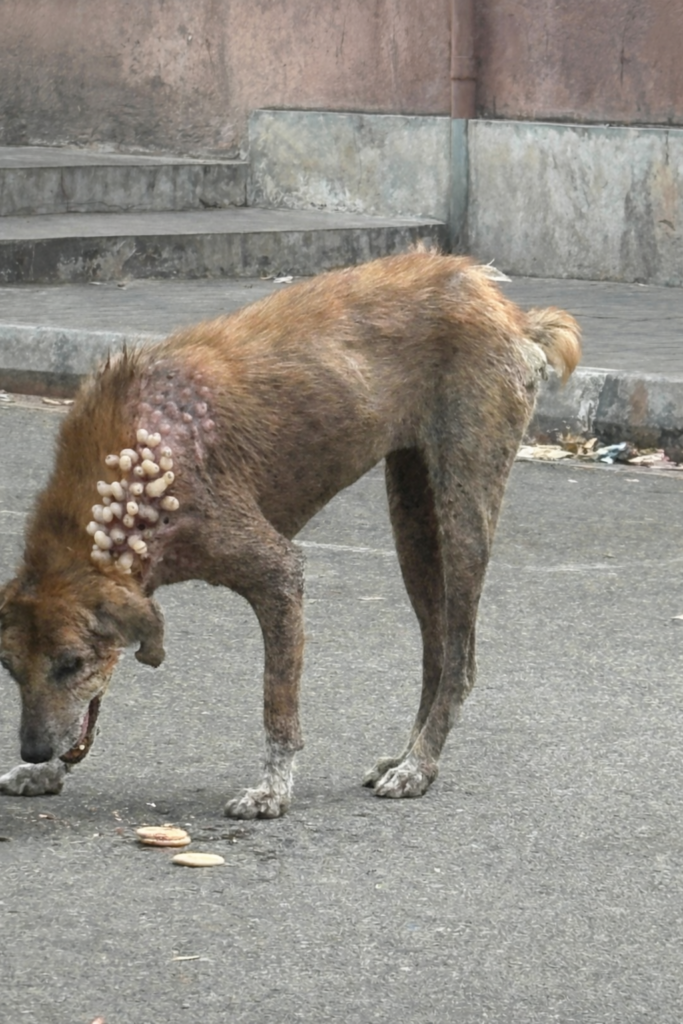
On a quiet roadside, where life rushes past without pause, a fragile figure stands almost unnoticed. A stray dog—thin, weak, and burdened with a condition too painful to ignore—lowers its head toward a few scattered pieces of food. Hunger has brought it here, but suffering defines its every movement. Its body tells a story of neglect, survival, and silent endurance.
The dog’s neck is covered in swollen, pale lumps—signs of a severe parasitic infection, commonly known as mango worms. These larvae burrow into the skin, feeding on the living tissue beneath. What looks disturbing to the human eye is, for the dog, an ongoing source of pain, irritation, and infection. Each step it takes is heavier than the last, not just from weakness but from the constant discomfort it cannot escape.
Stray animals live a life most of us will never truly understand. They are born into uncertainty, grow up without protection, and survive by instinct alone. For this dog, every day is a battle—for food, for safety, and now, for relief from a condition that slowly drains its strength. There is no shelter to rest in, no caretaker to clean its wounds, and no voice to ask for help.
Its fur, once likely soft and full, now appears patchy and dull. Signs of malnutrition are visible across its body. Its ribs faintly show beneath its skin, and its posture speaks of exhaustion. Yet, even in this weakened state, it continues to search for food. Survival does not wait for healing.
People pass by. Some notice, some don’t. A few may feel a moment of sympathy, but life moves on quickly. In busy streets and crowded cities, such scenes are not uncommon. But just because something is common does not make it any less tragic. Each stray animal has its own story—one of abandonment, resilience, and often, unnoticed suffering.
This dog, in particular, seems to carry a heavier burden. The visible infection is not just a health issue—it is a reflection of a larger problem. Lack of awareness, limited access to veterinary care, and indifference all contribute to situations like this. Mango worms thrive in environments where hygiene is poor and medical attention is absent. For stray animals, this creates a cycle that is difficult to break.
Imagine the constant discomfort—itching that cannot be relieved, wounds that cannot be cleaned, and pain that never fully fades. The dog cannot understand why this is happening. It only knows that something is wrong. And yet, it continues to stand, to walk, to eat—because giving up is not an option it recognizes.
There is a quiet strength in animals like this. Despite everything, they endure. They adapt to harsh conditions, find food where they can, and keep moving forward. But endurance should not be mistaken for well-being. Survival is not the same as living.
This moment—the dog eating on the roadside—is both heartbreaking and revealing. It shows how close help could be, yet how far it often feels. A small act of kindness, a call to a local animal rescue, or even basic awareness could change the outcome for animals like this. Treatment for such infections exists. With proper care, wounds can heal, parasites can be removed, and the dog could regain its strength.
But for that to happen, someone must notice—and care enough to act.
Street dogs are part of our communities, whether we acknowledge them or not. They live alongside us, share our spaces, and depend, in many ways, on human presence for survival. Yet, they are often the most overlooked. Their pain remains invisible until it becomes too severe to ignore.
Looking at this dog, it’s impossible not to feel a sense of sadness. Not just for its physical condition, but for the loneliness of its existence. There is no one to comfort it, no one to ensure it will be okay. Its life depends on chance—on whether someone chooses to help or walk away.
And still, it eats. Slowly, carefully, as if aware that every bite matters. Hunger is immediate; pain is constant. But in that moment, food provides a brief distraction, a small relief from a much larger struggle.
What makes this story truly heartbreaking is not just the suffering—it is the silence surrounding it. Animals do not speak our language. They cannot explain their pain or ask for help. They rely entirely on human compassion. And when that compassion is missing, their suffering continues unnoticed.
This image is not just about one dog. It represents thousands of animals facing similar conditions every day. It is a reminder of the responsibility that comes with sharing our world with other living beings. Compassion is not a luxury—it is a necessity.
If there is one thing this scene teaches us, it is that even small actions can make a difference. A single act of care can change the course of an animal’s life. Awareness can lead to action, and action can lead to healing.
The dog may not know it, but its story matters. It is a story that deserves to be seen, to be felt, and most importantly, to inspire change. Because behind every stray animal is a life worth saving—a life that, with a little help, could be free from pain and full of hope.
Until then, it stands there—quietly enduring, silently hoping, and unknowingly reminding us of the power of kindness.