
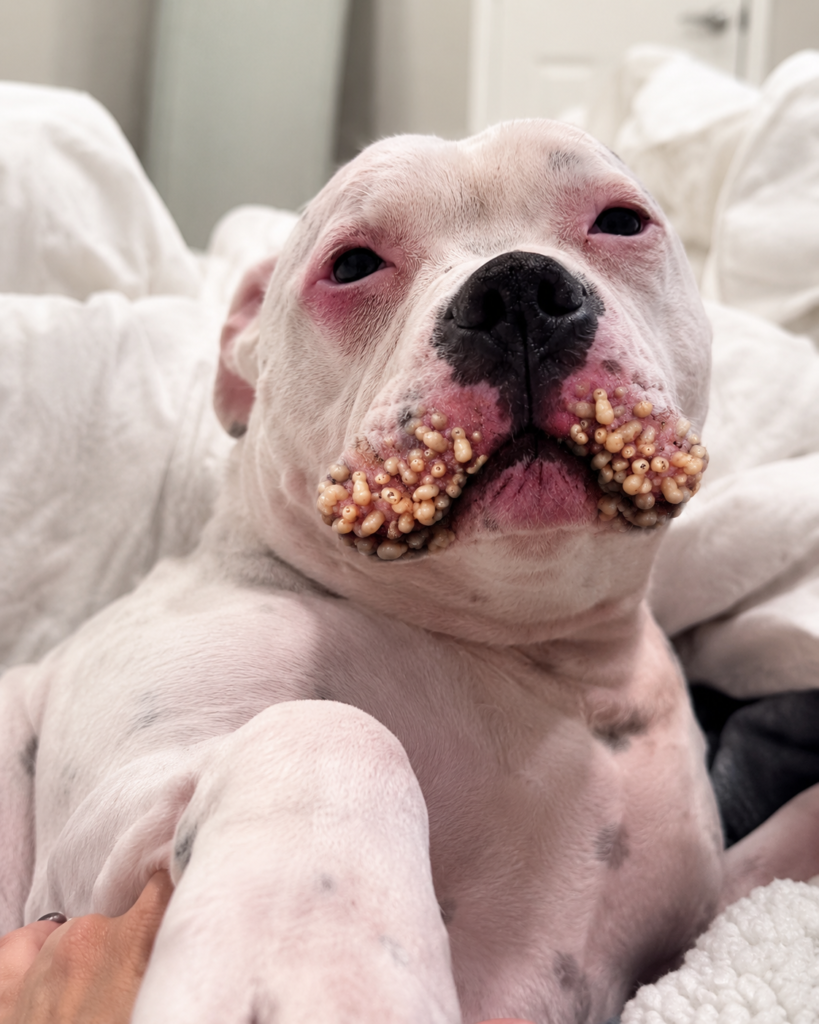
The first time anyone saw him, he was lying under a broken wooden cart near the edge of an empty road. Cars passed without slowing down. People walked by pretending not to notice the weak white dog curled into himself like he was trying to disappear from the world. His body was thin, his eyes swollen and red, and around his lips strange painful growths had spread across his skin. Every movement seemed to hurt him. Even breathing looked difficult.
No one knew how long he had been there.
Some people felt sorry for him for a moment, but pity is easy when it costs nothing. They looked, whispered softly, and kept walking. A few children pointed at his face and became frightened. Others laughed because they had never seen a dog look so different before. Day after day, the dog remained there silently, watching the world reject him without making a sound.
Rain fell during the nights. The cold ground soaked into his bones. Hunger twisted inside his stomach until he no longer had the strength to stand properly. Yet somehow he survived.
Perhaps he was waiting for someone.
One evening, a woman named Clara was driving home after finishing work at a small animal clinic. She almost missed him because the light was fading and the road was quiet. But something made her slow down. She noticed two dark eyes staring from beneath the broken cart. They were not angry eyes. They were tired eyes. Eyes that had stopped expecting kindness.
Clara stepped out slowly.
“It’s okay,” she whispered.
The dog tried to move backward, but pain stopped him. His body trembled violently. Up close, Clara could see how serious his condition was. The growths around his mouth were infected. His skin was irritated and swollen. Someone had probably abandoned him after his illness became too difficult or expensive to treat.
But what hurt Clara the most was not his condition.
It was the way he avoided looking directly at her.
As if he believed he was too ugly to be loved.
Clara wrapped him gently in a blanket and carried him into her car. He did not resist. It was almost as though he had already surrendered to whatever fate waited for him.
At the clinic, the staff worked carefully through the night. The dog was dehydrated, malnourished, and exhausted. One of the veterinarians explained that his condition would require long treatment and patience. Recovery would not happen quickly.
“Will he survive?” Clara asked quietly.
The veterinarian looked at the sleeping dog for a long moment.
“If he decides to fight, maybe.”
They named him Oliver.
During the first few days, Oliver barely moved. He refused food at times and spent hours staring at the wall. Whenever someone approached too quickly, fear flashed across his face. It was clear he had suffered not only physically but emotionally. Dogs remember pain differently than humans, but they remember abandonment very deeply.
Clara visited him every morning before work and every evening before going home. She sat beside him without forcing interaction. Sometimes she simply read aloud from a book while Oliver listened quietly.
One night, as rain tapped against the clinic windows, Clara noticed something small but important.
Oliver had moved closer to her chair.
Not much. Only a few inches.
But for a broken animal learning to trust again, a few inches can mean everything.
Weeks passed slowly.
The treatments were painful, and there were moments when Oliver seemed ready to give up. Some days he refused to lift his head. Other days he cried softly during cleaning procedures. Yet Clara never stopped speaking gently to him.
“You are still beautiful,” she would whisper.
At first, Oliver did not believe her.
How could he?
Every mirror showed him a face covered with painful growths. Every reflection reminded him why people looked away. Even when volunteers visited the clinic, many chose healthier dogs to pet first. Oliver noticed these things. Animals always notice more than humans think.
One afternoon, a little boy came to the clinic with his mother. He walked past the playful puppies and stopped directly in front of Oliver’s bed.
“What happened to him?” the boy asked softly.
“He’s sick,” Clara explained.
The child looked carefully at Oliver for several seconds. Then he smiled.
“He still looks kind.”
Clara felt tears burn her eyes.
That was the first time Oliver wagged his tail.
It happened slowly, uncertainly, like he had forgotten how.
From that day forward, something changed inside him.
Healing became visible little by little. The swelling around his eyes reduced. His appetite returned. He began walking outside in the mornings, enjoying sunlight on his fur. Volunteers who once hesitated now sat beside him. They discovered he loved resting his head gently against human hands.
But scars remained.
Not all wounds disappear completely.
Sometimes Oliver caught sight of himself in reflective glass and immediately looked away. Clara understood that recovery is not only about medicine. It is also about learning you deserve love after the world convinced you otherwise.
Months later, the clinic shared Oliver’s story online hoping someone might adopt him. Thousands of people reacted. Many cried after seeing his old photographs beside his newer ones. Messages arrived from strangers around the world.
One comment said:
“I thought my own scars made me unlovable until I saw this dog fighting to live.”
Another wrote:
“Oliver reminds me that survival itself is courage.”
The story spread farther than anyone expected.
But Oliver did not care about internet attention.
He cared about simple things.
Warm blankets.
Gentle voices.
A safe place to sleep.
The feeling of not being abandoned anymore.
Then one winter morning, an elderly man named Henry visited the clinic. He had recently lost his wife and lived alone in a quiet house near the countryside. He walked slowly through the kennels until he stopped in front of Oliver.
Unlike others, Henry did not stare at the scars.
He sat down beside him immediately.
For nearly an hour, neither of them moved much. They simply existed together in silence — two souls who understood loneliness better than words could explain.
Finally, Henry looked at Clara.
“I think he’s tired of being left behind,” he said softly.
Clara smiled through tears.
“So are you.”
That afternoon, Henry took Oliver home.
The frightened dog who once hid beneath a broken cart now slept beside a fireplace every night. He followed Henry through the garden, rested beside him during quiet evenings, and slowly learned that home was not just a place.
Home was safety.
Home was patience.
Home was love that stayed.
Neighbors often stopped to meet Oliver during walks. Some still stared at the scars around his mouth, but Henry never seemed embarrassed. Whenever people asked what happened to him, Henry answered the same way every time.
“Life happened,” he would say gently. “But he survived.”
And perhaps that is why Oliver’s story touched so many hearts.
Because deep down, people understood him.
Many humans carry invisible scars the same way Oliver carried visible ones. Some hide pain behind smiles. Others stop believing they deserve kindness after experiencing cruelty, rejection, or abandonment. Like Oliver, they begin avoiding mirrors — not because they hate their reflection, but because they fear nobody else could ever love it.
Yet healing becomes possible when even one person chooses compassion instead of judgment.
One person who stays.
One person who sees suffering and does not walk away.
Oliver never became a perfectly healthy dog. Some scars remained forever. But in the end, scars did not define his worth.
Love did.
And every night, before sleeping beside the warm fireplace, Oliver would close his tired eyes peacefully — no longer wondering whether he mattered.
Because at last, someone had shown him that even broken hearts still deserve a home.