
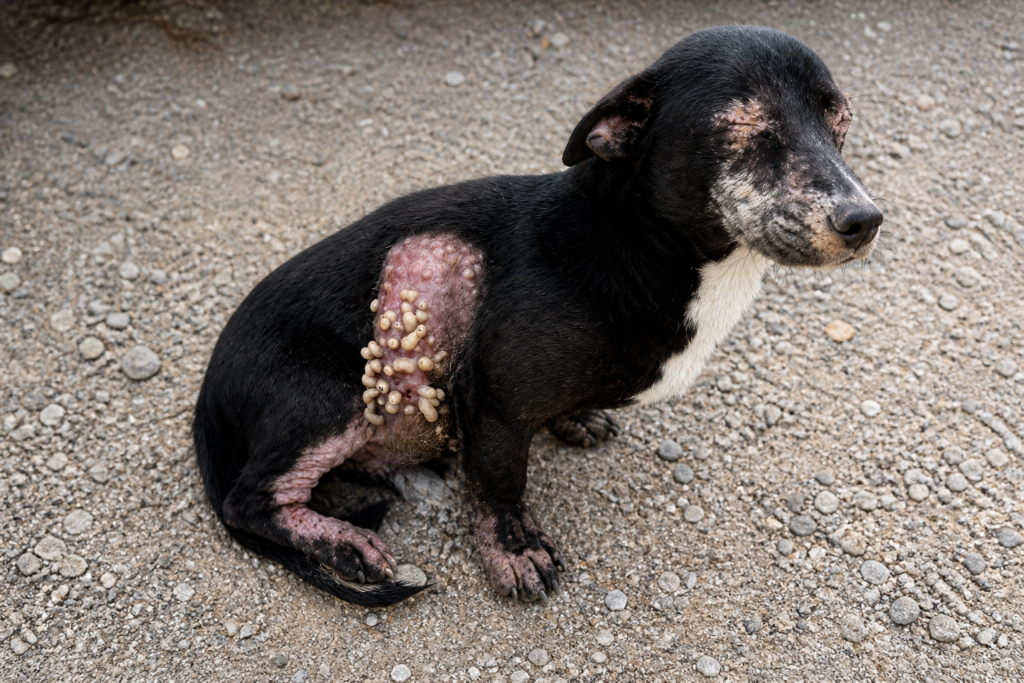
The stray dog sat quietly on the rough gravel ground, its frail body curled inward as if trying to protect itself from a world that had long stopped showing it kindness. Its once-glossy coat was now patchy and dull, with bare, irritated skin exposed in several places, telling a silent story of neglect, disease, and survival. The dog’s eyes, half-closed and heavy with exhaustion, seemed to carry a depth of pain that words could never fully capture. Each breath it took was slow and deliberate, as though even the simple act of breathing required effort. Around it, the environment was harsh and unforgiving—dry earth, scattered stones, and no sign of comfort or shelter. People passed by occasionally, some casting brief glances, others ignoring it completely, as if the dog had become just another invisible part of the landscape.
Once, perhaps, this dog had known warmth—a home, a human touch, a sense of belonging. But now, it lived on the margins, surviving on scraps and instinct. Its body bore signs of illness, with visible sores and growths that had gone untreated for far too long. These weren’t just physical wounds; they were reminders of how easily life can turn when care disappears. The dog didn’t bark or beg. It simply existed, quietly enduring its condition, as if it had accepted this suffering as its fate. Yet, even in its weakened state, there was a quiet resilience in the way it held itself, a refusal to completely give up.
The gravel beneath it was uneven and uncomfortable, but it seemed to be the only place it could rest without being disturbed. Every so often, it would shift slightly, trying to find a less painful position, but relief never truly came. Its ears twitched at distant sounds—footsteps, voices, the hum of passing vehicles—but it made no attempt to move toward them. Perhaps it had learned that not every sound meant help. Trust, once broken repeatedly, becomes difficult to rebuild, even for an animal.
The world around the dog continued as usual. Life moved forward—busy, loud, indifferent. Yet in that small, quiet corner, time felt slower. The dog’s presence was a stark contrast to the pace of everything else, forcing anyone who truly noticed to pause and reflect. It wasn’t just a sick animal; it was a living reminder of neglect, of the silent struggles that often go unseen. There was a certain dignity in the way it endured its suffering without complaint, a kind of strength that didn’t rely on noise or attention.
One could imagine the journey that led it here—perhaps it had wandered too far from home and never found its way back, or maybe it had been abandoned when it became too sick to care for. The exact story remained unknown, but the result was painfully visible. Hunger, illness, and loneliness had all left their marks. And yet, despite everything, the dog was still there, still breathing, still holding on.
For a moment, someone stopped nearby and looked a little longer than the others. Their expression changed—from curiosity to concern. It was a small moment, but an important one. Because sometimes, all it takes is one person to notice, to care, to act. The dog didn’t move, didn’t react much, but perhaps somewhere deep inside, it still held onto a faint hope that help might come.
This scene, simple yet heavy with meaning, reflects a larger reality. There are countless animals like this dog, living in silence, enduring pain without a voice to express it. Their struggles often remain hidden in plain sight, overlooked by a world that moves too fast to stop. But every life, no matter how small or fragile, carries value. And every act of compassion, no matter how small, has the power to change a story.
As the day went on, the light shifted, casting longer shadows across the gravel. The dog remained in its place, still and quiet, a symbol of both suffering and resilience. Its story may not be widely known, but it is real, and it matters. And perhaps, somewhere in that stillness, there is a chance—a fragile but meaningful possibility—that its story could take a different turn, one shaped not by neglect, but by care, kindness, and a second chance at life.