
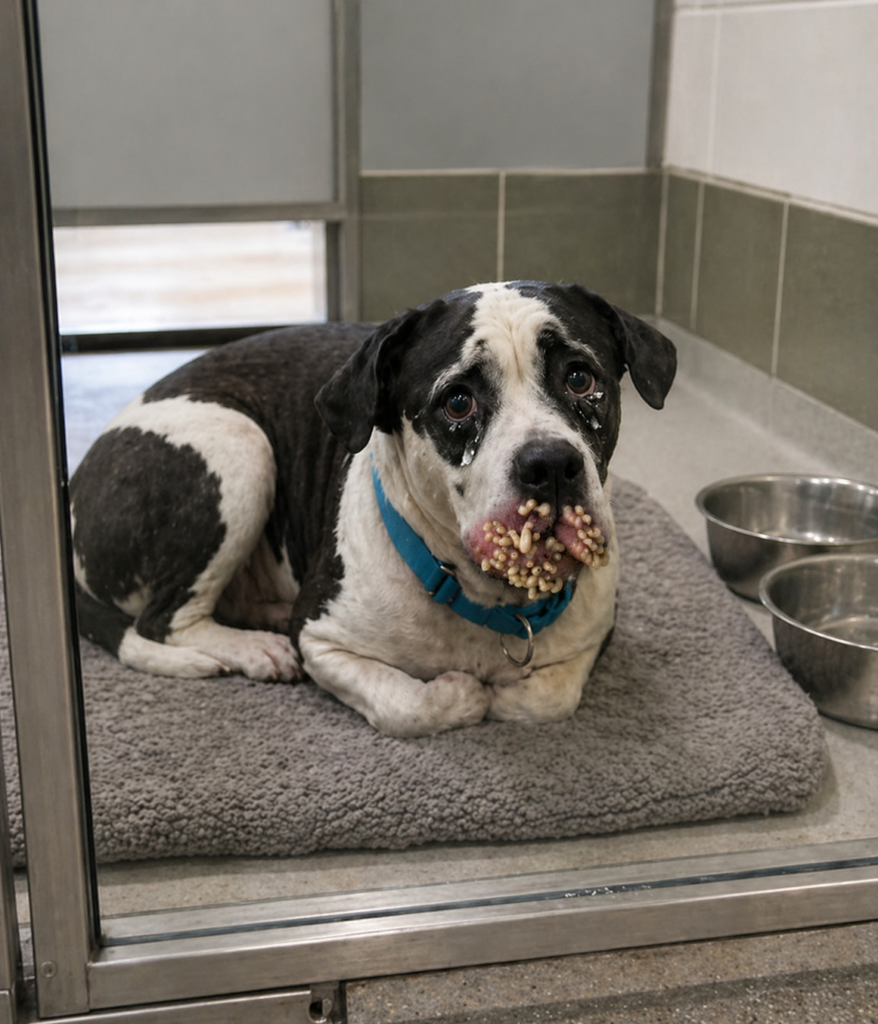
He lay quietly on a thin, worn mat, his fragile body curled into itself as if trying to hide from the pain that had become his constant companion. The small room around him felt cold and unfamiliar, with smooth walls and the faint echo of distant sounds that he did not understand. Once, the world had been open and full of movement, smells, and small joys. Now, it had narrowed into this quiet corner where every breath felt heavy and every moment stretched longer than it should.
His face told a story no one could ignore. Painful swellings had taken over his mouth, making even the simplest act—eating—feel like an unbearable task. Food, which once brought comfort and energy, now sat untouched or only barely disturbed. Hunger still lived inside him, but it battled against the sharp, constant discomfort that came with every attempt to chew or swallow. His lips, swollen and wounded, made it difficult for him to express himself the only way he knew how. Instead of barks or playful sounds, there was only silence and the occasional soft whimper that escaped without warning.
But it was his eyes that spoke the loudest. They were filled with a deep sadness, a quiet confusion, and a longing that words could never fully describe. Those eyes followed every movement, every shadow, every passing figure, as if searching for something familiar—something safe. They held a question that no one had yet answered: “What happened to me, and why am I alone in this pain?” There was no anger in them, no sign of blame—only a gentle, heartbreaking hope that someone might understand.
Every small movement he made seemed like a great effort. Lifting his head, shifting his body, even adjusting his paws required strength that he barely had. His body, once capable of running and playing, now felt heavy and slow, as if weighed down by more than just illness. Yet, despite everything, he did not give up. He remained still, conserving what little energy he had, waiting for something to change.
Beside him sat two metal bowls—simple, ordinary objects that had once been a source of comfort. Now, they were reminders of a life that had become difficult. One held water, reflecting a faint image of his tired face, while the other held food that he struggled to eat. They represented care, yes, but also the reality of his condition. He wanted to eat, to feel full, to regain strength, but his body would not allow it without pain.
There was a time, not so long ago, when he trusted easily. A human hand reaching out meant affection, safety, and warmth. He likely knew what it felt like to be petted gently, to be spoken to in soft tones, to belong somewhere. But something had changed. Whether it was neglect, abandonment, or simply the cruelty of illness, he now carried a quiet uncertainty within him. When someone approached, he did not react with excitement or fear—only a cautious stillness, as if unsure of what to expect.
And yet, even in this state, there was something remarkable about him. He had not lost his ability to hope. It was there, hidden but visible, in the way he looked at people who passed by. It was there in the way his eyes softened when someone came close, as if he still believed that kindness could return to his life. That small spark of hope refused to go out, no matter how much pain surrounded it.
His story is one of silent endurance. Animals like him do not complain in ways humans easily understand. They do not explain their suffering with words or demand attention. Instead, they endure, they wait, and they hope. He is living proof of that quiet strength. Even as his body struggles, his spirit continues to hold on, refusing to completely fade.
Looking at him, it becomes impossible to ignore the deeper truth—animals feel pain, loneliness, and fear just as deeply as humans do. They experience hunger, discomfort, and emotional loss, yet they face it without the ability to ask for help. That is what makes his story so powerful. It is not just about one sick dog lying on a mat; it is about all the unheard voices, all the silent struggles that happen every day.
He does not need grand gestures or complicated solutions. What he needs is simple, yet incredibly important—care, compassion, and a chance to heal. With proper treatment, gentle attention, and patience, his life could change. The pain that defines his days could be reduced. The fear and uncertainty could be replaced with trust once again. He could feel what it means to be safe.
There is something deeply moving about the way he continues to exist despite everything. He does not fight loudly or dramatically. His strength is quiet, almost invisible, but it is there in every breath he takes. It is there in the way he stays present, in the way he has not completely shut himself off from the world.
Perhaps the most heartbreaking part of his story is how easily it could have been different. With early care, with attention, with someone noticing his condition sooner, he might not have reached this level of suffering. But regret does not change the present. What matters now is what happens next—whether someone chooses to act, to help, to care.
He is still here. Still breathing. Still waiting.
And in that waiting, there is a message for anyone willing to see it. A message about kindness, about responsibility, and about the quiet lives that depend on human compassion. He may not be able to speak, but his story is loud enough for those who choose to listen.
In the end, he is not just a sick dog lying in a corner. He is a symbol of resilience, a reminder of the importance of empathy, and a living being who deserves a chance at comfort and care. His pain does not define his worth. His suffering does not erase his need for love.
Somewhere behind those tired eyes, beyond the pain and the silence, there is still a part of him that believes things can get better. And sometimes, that small belief is all it takes to begin a new chapter—a chapter where pain is replaced with healing, and loneliness is replaced with compassion.
Until then, he waits… quietly, patiently, and hopefully.