
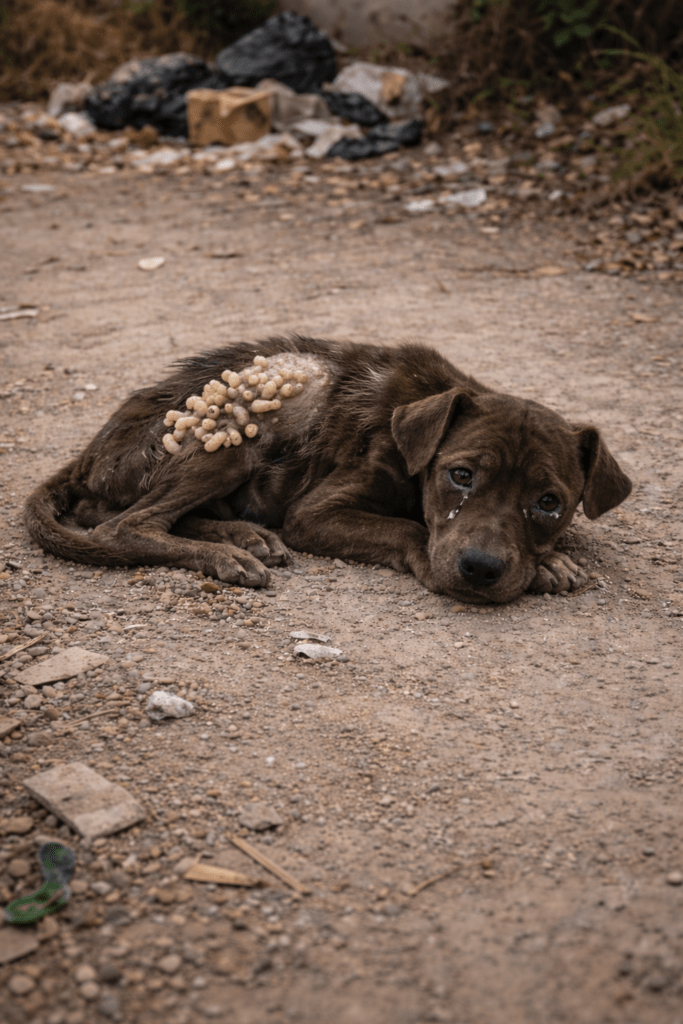
He was lying there, curled into himself beside a pile of garbage, as if the world had already forgotten him—and maybe it had. The ground beneath him was hard and unforgiving, scattered with broken pieces of glass, plastic, and dust that clung to his weak body. The smell of the trash was heavy in the air, but he didn’t move away. He didn’t have the strength to. Once, he might have run freely, chasing after sounds, wagging his tail at strangers, hoping for a gentle touch. But now, all that remained was a small, trembling body and eyes filled with quiet pain.
His fur, once soft and warm, was now dull and patchy. On his side, a terrible wound had grown—swollen, infected, and crawling with parasites. The pain must have been unbearable, but he didn’t cry out loudly anymore. Maybe he had learned that no one was listening. Maybe he had cried before, and no one came. So now, he lay silently, only the faint rise and fall of his chest proving he was still alive.
People passed by him every day. Some glanced at him with disgust, others with pity, but no one stopped. A few covered their noses, whispering about how “dirty” and “ugly” he looked. Children pointed at him, curious but quickly pulled away by adults who warned them not to go near. To them, he was just another stray, another broken thing among the many discarded pieces of the world. No one saw the life inside him, the fear, the loneliness, the desperate need for kindness.
If you looked closely into his eyes, though, you could see something else—something that hadn’t completely faded. A tiny spark of hope. It flickered weakly, like a candle about to go out, but it was there. Maybe he still believed someone would come. Maybe he still remembered what it felt like to be loved.
Days passed, and his condition worsened. The wound grew larger, the infection deeper. His body grew thinner as hunger gnawed at him. Sometimes he tried to stand, but his legs trembled and gave way beneath him. Each attempt left him more exhausted than before. So he stayed where he was, waiting—not for anything specific, just waiting. Waiting for the pain to end, or for something to change.
One evening, as the sun dipped low and painted the sky in shades of orange and red, something finally did.
A man walking by noticed him—not just a passing glance, not a look of disgust or indifference, but a real, lingering look. He stopped. For a moment, he simply stood there, taking in the sight of the small, suffering dog lying helplessly near the trash. Most people would have kept walking. It was easier that way. But something in those tired, tear-filled eyes made it impossible for him to leave.
He slowly approached, careful not to startle the dog. The puppy flinched slightly, his body tensing as if expecting harm. Maybe he had been hurt before. Maybe every human hand he had known had brought pain instead of comfort. But the man’s voice was soft, gentle, and calm. He knelt down, speaking quietly, trying to reassure him.
“It’s okay… I’m not going to hurt you.”
The dog didn’t understand the words, but he felt the tone. It was different. There was no anger, no fear—just kindness. And for the first time in what felt like forever, he didn’t pull away.
The man could see the severity of the wound, the parasites embedded in his skin, the weakness in his body. It wasn’t just neglect—it was suffering, deep and ongoing. Carefully, he reached out and touched the dog’s head. The puppy didn’t resist. Instead, he closed his eyes for a brief moment, as if savoring the feeling of a gentle touch he had almost forgotten.
That was enough.
The man knew he couldn’t leave him there.
Gently, he wrapped the fragile body in a piece of cloth and lifted him. The dog was so light—far too light for his size. As he was carried away from the garbage heap, his head rested weakly against the man’s arm. For the first time in days, he was no longer alone.
The journey that followed wasn’t easy. The dog needed urgent care. At the clinic, the veterinarians worked carefully to treat his wounds. Removing the parasites was a slow and painful process, but they did it with patience and care. They cleaned the infection, gave him medicine, and made sure he was as comfortable as possible.
Through it all, the dog remained quiet. He didn’t fight. He didn’t cry out much. It was as if he understood that this pain was different—that it was leading him somewhere better.
Days turned into weeks.
Slowly, almost unbelievably, he began to heal.
The wound that once defined him started to close. His strength began to return. He started eating again, first hesitantly, then with growing appetite. His fur, though still thin, began to show signs of life. And his eyes… those sad, tired eyes began to change.
The fear didn’t disappear overnight. Neither did the memories of abandonment. But alongside them, something new was growing—trust.
He began to wag his tail, just a little at first. He responded to voices, to footsteps, to kindness. He followed the man who had rescued him, staying close as if afraid he might disappear too.
But this time, he didn’t.
The man became his home, his safety, his second chance.
And the dog who once lay forgotten beside a pile of garbage slowly became something else—a survivor. A living reminder that even in the darkest places, even in the deepest suffering, a single act of kindness can change everything.
His scars didn’t vanish completely. They remained as a quiet testament to what he had endured. But they no longer defined him. Instead, they told a story—not just of pain, but of rescue, healing, and hope.
Because sometimes, all it takes is one person to stop… to care… to see what everyone else has chosen to ignore.
And for that little dog, that one moment made the difference between dying alone in the dirt… and finally, learning what it means to be loved.